
This is an interview Series for the National Film and Sound Archive Aural History Programme.
My name is John Fife (JF) and I have with me Morrie Pilens (MP).
JF: Was that when you won your Thorn Award?
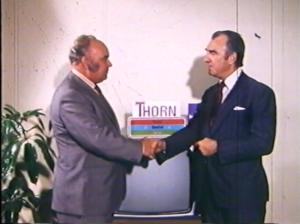
MP: No, one Thorn Award was for a bus coming down Heidelberg hill without brakes and going into Banyule park. The poor bastard was coming down, beeping his horn, right across the bridge and jumping. Loaded with kids. I got there afterwards anyway, but it was a big story.
So regularly, every five years, I used to get a big one. One story I covered was the Australian Royal Society was having a get together and Governor General Kerr (Sir John) was going to be the guest of honour. So, night time job, I say yeah, I’ll do it.
The Royal Society was in Queens Road in Albert Park. So we’re there and I’m filming this demonstration outside. And we’re there and there are people making a bit of fun…
JF: This was after Kerr had dismissed Whitlam?
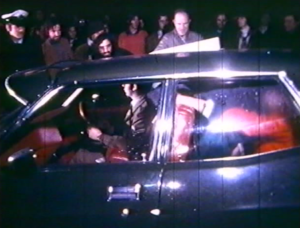
MP: Yeah. In comes a calvalcade with Kerr, and eggs come onto the car, one bloke had a loudhailer and jumped on the bonnet, whacked the windscreen on it, the car drove in, BIG problem, you know. There was police attacked with sticks and what have you. Good action film!
After that, I couldn’t get to a demonstration, I couldn’t get to a night job any more – because everyone else wanted to get them. They thought they were going to get an award!
(Laughter)
By showing it can be done, you gather the momentum of the rest of your crew to go with it. And that’s the chief cameraman’s job. Not sitting and bloody driving a desk.
JF: No, you’ve got to have done the job to understand what going out on the road’s about
MP: And you’ve got to have people that are willing to come with the momentum and do the things you are. But later on, with tape, things wasn’t the same.
Another good one was Miss Australia.
JF: Just before you tell me about that, what makes a good cameraman?
MP: Good news cameraman is basically brave and alert. Willing to take risks, willing to take this, willing to do this. I’m not afraid of it. Doesn’t matter if it’s a confrontation or a disaster or what have you. You brave enough to take risks. The other one is alert. I don’t know which is more important, one or the other.
And then, making a decision. And when you make a decision – with a news cameraman it’s, well, the way I see things is… you going out on the job and you’re alert to your surroundings, and you’re going to be alert of a framed composition. How you’re going to frame this and how you’re going to frame that. And if you see a nice frame, be it an aesthetic building with a branch leaning in front for your composition, and a figure in there – that’s nice! And this is the same thing in disasters. You try and create your frame as you go along, as you see it, as you watch it. This is alertness comes in.
JF: But an arty farty guy isn’t a good news cameraman?
MP: No. Because arty farty guy basically doesn’t really know what he wants. He says ‘oh, it’d be nice if I did that here. No wait a minute, if I just… I can reset it and do it there.’ He’s too slow. He can’t make up his mind. He’s not willing to take a risk.
A news cameraman if he takes a risk and makes a mistake in his mind, switch it off, forget about it. It’s only a couple of frames, get it somewhere else. But arty farty guy has to reset it somewhere else. Or do something else. Or the light’s not right. Or this is not right. Because he doesn’t really commit himself to a frame. He wants to create a frame.
JF: But often if you’re shooting news, you’ve got to shoot it there…
MP: You’ve got to shoot it as it goes, but at the same time you’ve got to compose it. You can’t shoot news without cutting heads off or legs off or what have you. You’ve still got to be award of illustrating properly.
JF: You’ve done the big ones. What was your first one – the one you remember? Stringing for ABC?
MP: Yeah, stringing for ABC was good fun because I was basically a useful tool for them to use it on, outside metropolitan area. Be it go kart racing or whatever.
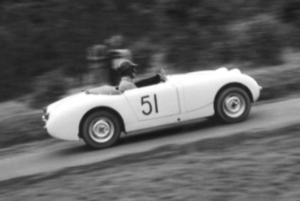
My specialty was motor cycles, creative and hill climb, or Austin 7 mud rallies – a hill climb in a mud rally with a dozen little Austin 7’s driving through mud. Some of the potholes were so deep that I think there’s still some cars buried that they never got out of there.
Another was flying. In Berwick we used to have a foreign minister of Menzies’ government, Lord Casey. His wife. They had a property at Berwick which was an airfield. On weekends they usually have tiger moths and gypsy moths flying around. Actually I was in the glider club down there but I gave it up when the kookaburra come in because I didn’t like an enclosed glider, I like an open cockpit glider.
Anyway, I got an assignment from ABC to go and film Lady Casey flying. So, I went there and watched them taking off. I watched other planes taking off, and bits and pieces and people around – the usual sort of make up. Then got into the tiger moth of Lady Casey. And we flying off, and doing a fly past the parking planes, planes are passing us. And I opened up – loosened up my safety belt in the front to turn around and get some shots of her piloting the plane, when she decided to do a loop! (Laughter).
*So I nearly learned how to fly without an aeroplane! So the ABC’s still got the film. Bob Grieve’s got the offcuts. I gave it to him.
JF: I bet that was the last time you ever undid your seatbelt on a plane…
MP: Yeah hea hea. I wouldn’t do that very often. But it was good fun. She was quite a character. A very good pilot. Well known. Actually I got to know the Casey’s – I wouldn’t say very very socially, but I was accepted with them. I had meetings with them when they walked into North Melbourne, you know, had cups of tea with them in the front room… yeah, it was good.
JF: ‘Cos you’ve got that ability with them – when you’re a cameraman, you meet people from the bottom right to the top.
MP: Yes, and when you’re a cameraman – especially a news cameraman, – oh, not now, any more – but you were accepted wherever you went. The highest of society or just in the coal mines, you know, it didn’t matter.
Talking about coal mines, I had a job. The Wonthaggi coal mines were closing down. So they move the horses, and they’re going to bring the last horses up there from the depth of the mines and what have you. I got job to go cover that. So we got down to the coal mines and put some stuff outside, coalminers, sentimental and what have you. So I said ‘Is the lift still working?’

‘Oh yeah, the lifts are still working. We’ve just got to bring some more horses up too.’
I said ‘Good, can I get into the cage because I want a shot of the camera going down the mine, looking upwards.?’
‘Oh yeah, no problem.’
So down we go, down goes the lift, I’m filming the hole getting smaller, smaller, smaller, finally disappering. Me down right the bottom somewhere, so they stop. They said ‘Okay, we’ve got to take a couple of horses up, then we’ll come and get you.’
I said ‘Oh, oh,…. Okay, no problem. Yep, I’ll wait.’ (Hushed dramatic voice) They left me down there for an hour.
JF: Ah.
MP: Left me down there for an hour. And then when they came looking for me, I was hiding! So they got panicky. (laughter). Screaming – mine’s still going all over the placed and I’m hiding. ‘You’re a good bloody bloke!’ I got a miner’s lantern and a hat! (laughter).
JF: And I guess that’s an example of one day you’re working with the miners…
MP: Next day with Prince Phillip. Oh yeah, I forgot to tell you about that. I used to have a Minolta camera with a mag stripe, the only one in Melbourne, off cuts put into the same processing. And I was taking some pictures of him, and he had some school kids that he was awarding or what have you.
And he came up and said (deep sonorous PP voice) ‘You don’t really get very good quality with that. I’ve got a Minox.’
And I said ‘Minox, yeah, camera made in Latvia originally as a spy camera. But this is twice the size.’
‘Oh, but it’s still not the same quality is it?’
I said ‘Well, it’s not too bad actually – I’ve got some good film.’ So I left it at that. Anyway he was poo pooing that it was small. I said, yeah, it’s only half the size, the Minolta is twice the size – 16mm – big film. And he said ‘oh, mumble mumble’ and off he went.
A couple of days later I had another job to cover him, and I brought him the film that I had taken which was a slide, just the 16mm slide with half a dozen pictures on it, with him in it. I said ‘Have a look at this!’
‘They are very good quality.’
I said ‘Yeah, it’s got a mag stripe on it!’ (laughter). Smartass! Of course bloody Minox is small.
JF: How many pictures would you get on your little…
MP: Nineteen. You load your own. So what I have done now, I made a special knife that I can cut a 35 mm film. And I have had 35 mm negative film c processing. You’ve just got to make sure that they trust you that that’s the right processing when you give it to them. C processing – I make prints as good as 35 mm. The quality’s absolutely superb. They just got rid of those camera’s too early. Because digital cameras, you know.
JF: We see a lot of changes in the industry – perhaps that’s a story for next time.
MP: (laughs) Yeah, perhaps.