
This is part of an interview Series for the National Film and Sound Archive Aural History Programme by John Fife.
My name is John Fife (JF) and I have with me Morrie Pilens (MP).
JF: Morrie is a television news cameraman, for many years. First as a stringer cameraman and then worked for mainly channel 0/10. I’m sure his story will enlighten us all today.
Morrie, there are a few things that I just need to do formally and that is to ask you if you have in fact read the terms and conditions of the interview and that you understand them.
MP: Yes I have read the terms and conditions and I agree with them, and I give my full consent to be used for whatever they want.
JF: That’s great. I know that the people at the National Film and Sound Archive have been really eager that we get this into the can, because they obviously appreciate your time as well, and the role that in fact you played in the creation of television news here in Australia.
Just for formal identification, I need you to tell me your date of birth as well.
MP: My name is Morrie Pilens. I’m born 13/6/1928 in Riga, Latvia.
JF: Latvia? That’s probably a nice place for us to start the whole interview. Tell me a little bit about your background and your upbringing.
MP: Well, I was born in an ordinary family. My father was a seaman and my mother was just home duties, a little bit of part time work. My education is roughly about 6 years in primary school, which was interrupted by whatever happened in Europe at the time. Laughs.
My association with films began early in my life, because as a kid after school I used to go and distribute flyers and put them in letterboxes on behalf of the local cinema, advertising the next attraction – for which as a 13/ 14 year old I could watch any movie I want from anywhere at all. If it was an adult movie and you couldn’t sit in the cinema, I was sitting behind the screen. The only obstruction being a great big square loudspeaker in the middle of the screen. Anyway, that’s the start of my association with film!
JF: So you had an interest in film really from childhood?
MP: Yep. Eventually – the fellows that ran the projectors are a pretty lazy bunch and they used to play cards – so as a kid I sort of graduated to run the projectors as well.
JF: What age are you now?
MP: I am 81 now
JF: No I mean at the time…
MP: I would have been roughly 14. The interesting thing was that we had films in various languages and when the films were projected, you had to run a little spool of subtitles which were separate and those had to be run by hand to correspond with what they were talking on the film. So basically that helped me pick up a little bit of German and a little bit of Russian – by running the subtitles.
JF: How did you know where to put a particular subtitle at a particular point in the film?
MP: Well, firstly the first projection was done by the chief projectionist. And we would all sit and watch. And you just had to remember when it happened – but after a while you sort of understood what was going on, really. You can almost lip read and that sort of thing. So that graduated me from there, from running film reels up and down, picking them up and delivering to cinema and what have you.
JF: Had you left school at this stage?
MP: No – at this time I was still at school. When I left school I got myself a job through this connection, I got myself a job with a Latvian film company called Riga Film, as a cadet. And I was supposed to be still going to school but school sort of disappeared by then. And I worked for the film company cleaning rusty tins and stacking stuff. Laughs.
The most memorable job was working in film processing. Film was processed in a dark room and as it was coming out through a slot in the wall to be put on a great big wooden drum, we had to clean it which was half methylated spirits and half water, and a piece of chamois that you put in your hand and the film came through.
So after about 20 minutes doing this you were as drunk as a skunk because the fumes of the methylated spirits really impressed you! Eventually I assisted a film cameraman – one particular one which I would have to mention because he was part of the film industry. I can’t remember his Christian name but his name was Stanke.
In good mood he was telling us stories how he worked for the Russian film industry that was developing in Russia, and he was one of the cameramen that had a camera filming Battleship Potemkin, in (Sergei Richard) Eisenstein’s classic. This is even admired today for its innovations.
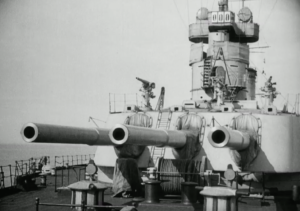
JF: So what were Riga films making? What kind of films?
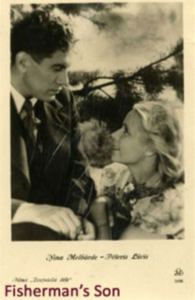
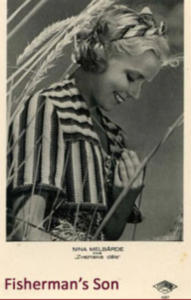
MP: Riga films actually made two films in Latvian language which was absolutely a stunning success because one was ‘Son of the fisherman’ (titled ‘The Fisherman’s Son’ in interview notes) – nothing to do with religion, this was a fishing village story.
And the other one was ‘Kauguriesi’ which showed life in the village when Latvia was still under Russian influence and Russian was coming in, picking up young men for their army. It was a beautifully done *film, especially the celebrations in Yaanni ? journeys day? The change of the season allows the peasants to celebrate and this particular celebration – it may be an old pagan festival, I don’t know – *and they’re drinking and singing. It’s a traditional festivity. It’s like zonner main? Like… dancing the maypole or what have you. That sort of celebration.
JF: So Riga are making movies. Are they making documentaries as well?
MP: Yes, they were making documentaries. We made documentary on – I particularly was IN, working in one documentary which was the Latvian ballet. Laughs. From all the things they were filming ‘Don Quixote’ – which Helpmann did in Australia years and years and years later. And I participated as an assistant cameraman in that particular one.
As an assistant I used to work in a studio. The sound system was such that there was a great big roll of film put on a turntable, which was enclosed in a glass box and that was the recording sound on film. And you were sitting there and watching, making sure – you don’t really have to do anything, it was working like tape recorder, because they didn’t have a tape recorder, this particular film was exposed on the film track. Made the dialogue on the film or a conversation in the film which was outside the box. So the assistant’s job was to sweat and lose weight in this contraption!
JF: So you’re starting to handle all kinds of flim equipment at that time?
MP: Oh Christ yeah.
JF: Have they let you loose with a camera at that point?
MP: I did have a chance of shooting I think about 20 seconds of ‘salut’ fired for an officer that had been killed in fighting in the Eastern Front. But otherwise we had to clean cameras, take them apart, clean and put them together again. I got into trouble. I cleaned a reflection and left too much oil on it. OOOH!! That wasn’t very funny. But that’s alright, things like that happen.
JF: But that’s why you started at the bottom and that’s the grounding for the industry.
MP: Well, that was the grounding for the industry THEN. I don’t know what it is now but that’s what you were doing. You didn’t have cars so you carted all the equipment in a two wheel cart, to the location where you were going to work. You did everything.
JF: Is this a small town or a large town?
MP: This is Riga, capital city of Latvia. Latvia has population of 2 million people. I don’t know how many people would be living in Riga. Anyway. After the Soviet Union was driven out of Latvia by the Germans, Riga Film continued as a unit and by 1943 it was taken over by Dr (Joseph) Geobbels’ Propaganda Unit and we were all put in uniforms.
JF: So now let me work this out
MP: Yeah, I’d be about 15. Yeah, so I was in SS uniform by the time I was 15. And a month after I got put in uniform we went out – the front was coming closer and closer and closer – I went out with my cameraman to a specific area just outside Latvia to do some filming where the Latvian units were, but we got separated and I got sort of left in one place and he disappeared somewhere else.
I had with me a tripod, a 12 volt car battery and 2 magazines which I had to look after. Laughs. You know, you’ve got to be a pretty strong little kid to cart all this around. Anyway, we got trapped in an encirclement, separated, I was somewhere and he was somewhere else, and I was able to guide the German unit that I was left with, out of that particular encirclement. So I got out and got back to Riga.
I decided to take a couple of days off – and meanwhile everybody was looking for me. They thought I was lost. Laughs. Anyway, I turned up a couple of days later and everything was alright.
JF: Then you came out of filming
MP: Oh, yeah.
JF: What else were you doing then, for the Propaganda Unit?
MP: For the propaganda unit we did all sorts of things. I remember there was this little Jewish fellow who was in SS uniform, supposedly being looked after as a mascot for one Latvian army unit. I think I have filmed that, I just can’t remember quite clearly. But this sort of thing. Also, opening factories and what have you.
JF: And you got to see a bit of war action as well?
*MP: Yes yes yes. I did go and get onto the war front. I think we went into Koolzeb? The Russians took over, and then they got kicked out and when we got in back there we filmed it, and we filmed a situation where they had really gone through like diahorrea.
They raped people, – nuns, they even got stuck into a TB hospital – the nurses and women that were violated in there. It was quite an impression to me, as to what’s happening. As a young kid I was still about 15 or 16. From then, I can’t remember the sequences somehow.
Oh, that’s right. Yes yes. The Latvian 15th division to which the film unit belonged, which was 6th Latvian War Correspondent Division – was sent to Pomerania. The 15th Division had a recuperation because they’d been on the front line for quite a long time, so this was reorganising and what have you.
*We finished up in a place called Sofianwold in Poland. We filmed some training – we filmed some exercises of how to destroy tanks and what have you. Bloody camera we had was a great big Debrie. A French camera which is a quite a heavy thing, so guess who’s carrying it around? (Me) Laughs.
JF: Are we talking 35 mm?
MP: Yes that’s right, there was no 16 then. The Yanks were the ones that brought in 16mm with their 16 mil combat cameras for the army. Up til then in Germany everything was in 35 mil.
JF: Was it hard work?
*MP: Yeah it was hard work. Hard yakka. Carting around – if he had an Arriflex that was no problem, that was terrific, marvellous. But they had a lot of other cameras that they confiscated, you know, French and Italian cameras and what have you. But I hadn’t had much to do with them. I’d worked with this particular Debrie. And it was bloody hard work anyway. Laughs.
JF: Morrie you were telling me about all of this heavy equipment and so on. What’s the next move for you? You’re still with the Propaganda Unit?
*MP: Yes, we’re still there, we’re in Sofianwold? , we are in Poland and filming exercises, help to destroy tanks and that sort of thing. And then all of a sudden the unit’s going to be disbanded.
JF: The Propaganda Unit?
MP: Yes. Chop chop! Things are tough, people are getting sent to combat units and god knows where.
JF: How many people were in the unit altogether?
Well, in that particular unit we were about 12. But in the meantime Riga film has been evacuated lock stock and barrel, to Germany in Tieringen. To establish operation in a village called Talberger. A niel *colsstas? factory in yenna? To make more propaganda films – but I don’t think they put everything together in time. Laughs. Befofre the war finished anyway.
JF: So Riga films have moved, and your Propaganda Unit is being disbanded.
MP: Yes.
JF: What happens to Morrie Pilens?
MP: Morrie Pilens got sent to Tieringen to join up with Riga film. BUT over Berlin – I got sent to Berlin, they were losing cameramen, pretty hectic – the lifespan of the cameramen was about 18 months, so Morrie Pilens got sent to Berlin to SS Standarte Kurt Eggars – the headquarters of Dr Geobbels’ Propaganda Unit. And I got sent there to be trained in taking over a camera. By this time I was about 16, 17 – but you teamed up with somebody.
And this training college – there were people from all over the world. In my particular squad was somebody from Finland, somebody from Norway, and I think a Frenchman and two Deutchmen…
A helicopter flies overhead
JF: We might just hang on there morrie, Mr Geobbels has come looking for you. That’s a helicopter!
Both laugh.
MP: Yeah oh yeah. Been there done that!
JF: And we were just sort of being physically trained as well. Everybody was equipped with guns and ammunitions, and we were psychologically trained – nobody took any notice of that bloody thing because they were already grown up journalists or photographers or radio guys. We just had to go along with it.
One of our jobs was, when Berlin got bombed, we got sent in to Berlin to assist. There were people you know, evacuated and dug out which we had to help. When the fire bombing started there were 4 tins of phosphorous got chucked down and whatever stuck to somebody would just burn right through and the army’s job was that if people are injured in such away that you could see they were being burned alive, the army’s job was to shoot them to put them out of misery. I haven’t done that, I didn’t do it but it happened – I saw it happen. Where a man runs around like a flaming torch covered in phosphorous and just being picked up like a running around rabbit, you know.
JF: You’re helping with this and also still doing a bit of filming?
MP: No, not at this time – well, it’s training filming. We just go out and pretend we do this and pretend we do that. What was interesting was that we were shown American war correspondent films. We saw the sinking of the aircraft carrier by Japanese kamikazes, and we sort of all said well how the bloody hell can we cover all that? You can’t cover all this. Your gear is just too inhibitive. And then it came out, the Yanks were using 16 mm cameras and colour.
We said “Oh, well, give us a go mate!” But we didn’t do any actual filming, we were just sort of working on it.
JF: When you said before that you were in Geobbels’ unit, did you actually get to see him?
*MP: Nah! NO! Don’t be silly. No. You’re just a number. But the SS Standarte Kurt Eggers – Press or Propaganda or what have you, that was it. You had radio guys down there, you had journalists, you had camera men, you had writers there . Everybody was under this particular standard, you know. But if you were Latvian you were in the Latvian section, if you were Dutch, you were in Dutch. If you were French, you were in French.
You were still under SS Standarte Kurt Eggers but you do whatever nationality your unit belonged to. So it was pretty privileged I tell you. You could go anywhere you wanted once you had a licence. Being war correspondent, nobody stopped you filming anything. There was no censorship. You just film and shoot anything and talk to anybody – BUT you seal your can, and the can goes to Berlin. (Prengant pause)
JF: AAAh ! Both laugh.
MP: But you can do whatever you want – photograph whatever you want. Seal your can, sign and stamp it. Off to Berlin. That’s the last you see of it.
JF: Okay.
MP: It’s good, isn’t it? Both laugh again
*It’s better than embedded in lynch? Isn’t it?
JF: At least it all got filmed, but where it all ended up….
MP: Well, it’s still all there and they’re using a lot of material from… Look, where do you think they got all those (images) of war in Pacific, and war in thingy a me bob or war somewhere else? That was all in the can – all stored on film that hasn’t disappeared.
If it was on tape you wouldn’t have it now, but on film for another 100 years it lasts. If you want it go look for it.
JF: So you’re still in Berlin…
MP: Yes I’m still in Berlin. And things get crook. Get a bit tighter and everybody getting nervous. And luckily, I don’t know how it happened, I don’t know who did it, but I got orders to go to Tieringen to join Latvian’s Riga film.
JF: Oh.
MP: And this is 2 or 3 months before Berlin fell.
So I’m given a couple of parcels to deliver in Tieringen, and put on the train.
“Bye bye Morrie, you can joint your Latvians!”
So I arrived there and of course the Latvian film company hadn’t established itself yet, everything’s still in the packs and what have you, and anyway, Riga Film remembered me and said ‘Oh, we want him – he’s ours”
We went in there and the war sort of hurried on, AND the Red Army arrived.
JF: You actually see them arriving?
*MP: Oh yeah, they stopped there for a while. Turned the turret one way and went BOOM! And hit a *hill. Turned the turret the other way and went BOOM! Hit the hill. Nobody answered them. They turned around, drove away. A couple of tanks. An hour later a tank and a lorry full of soldiers arrived…
… But before that, about 3 days before that, we did some plundering! We got onto a storage – a *luftwafer? storage place that had champagne from France, and cognac, and sugar and uniforms, and boots and you know… so we did some good plundering!
And we hid some of it in the potato cellar and some of it at home. I had a case of brandy at home and a couple of bottles of champagne. The brandy was Hennessy but I don’t remember what the champagne was.
Anyway. So the army arrive. They’ve discovered that there’s no resistance from this particular little village so they come in, turn up. All males in Latvian film company are rounded up. Put in the truck and taken to the Red Army headquarters for demilitrification.
So we arrive there at the hotel they confiscated .. so they’re feeding us and what have you, and they call us all in. “Look, we know who you are, we know what you’re doing, we’re going to take you back, just carry on”
This was the sum of it!
This was the sum of the demilitrification! Red Army people. They knew who we were. They knew that we weren’t bloody Nazis. Anyway. We all go back to Talberger. So we decided to shout them a party.
So we turn on a party. We turn on the drinks, THEY turn on the food. In comes the 6 parcels with food and commonwealth wine and the Yanks bring some German girls from up there, and we had this big room which was supposed to be a studio – and the party goes on for about a week. Grog’s flowing and food’s flowing and everybody’s happy. The Yanks are coming and going and you know, it’s just a big party.
*Anyway, I think one night they ran out of grog. So one of Fallgusy’s? amazing bastard, got onto a Yank sergeant who said ‘Come on, we’ll go in a jeep and pick up some grog.” They’d seen to the potato cellar! So that party continues, that’s okay, everybody’s drunk. The next day we’ve gotta go and clean up, so we better bring the grog in. We go up to the potato cellar. All gone! Cleaned out! Just the straw covers from champagne bottles left! That was the end of the party.
JF: And really, coming up to the end of your war?
MP: My war’s finished! That’s no problem. Except all of a sudden the Yanks turned up and said “Look, you’ve got 24 hours to pack everything. We’ll bring you the trucks. Because the Russians are taking over this area.”
We didn’t know the partition was going to be and what have you. So Tieringen was going to be under the Russians. We pack everything we had on the back of the trucks and just off we go to Vienna.
As we’re going to Vienna one way, the Russians coming in from the other side and we crossing… they in their horse and cart drawn vehicles. So the Yanks loaded us on the train and took us off. We finished up in the so called British zone which was Blomberg, which was turned into a displaced persons camp. Which Riga Film established itself, reinvented itself.
That’s another story. If you want to carry on with it? When we finish up with Blomberg.
And Blomberg finished up as the artists’ colony of that particular British realm … we had singers, dancers, film directors, dancers, painters, sculptors, musicians, soloists. It turned into a complete artists’ colony. Now Riga Film was doing bit of… we did one film for the British Control Commission, but mainly we did concerts for them.
JF: Morrie doing concerts?
MP: Yes, Morrie’s doing concerts! It’s alright, don’t worry about Morrie doing concerts!
We had a very famous Latvian string quartet which the British really enjoyed… we had a company that was putting on opera, I was in it as an extra, singing, playing with the girls! This sort of thing was sort of happening there. We had a drama studio which I attended, run by – I’m name dropping now – by one of *Stanislavski’s original students, yannis coutter(?)
JF: Wow.
MP: So there’s another little bit of name dropping. Association with early theatre. Yeah, I’ve been in a couple of plays –
JF: So you’ve
MP: Hang on one minute, I’ll tell you just a bit more.
*So we’re having fun and games, it comes up johnny’s day ? You know, johnny’s day mentioned about *the film ‘Calgary’? So we get drunk and carry on. One of the young fellows borrowed his father’s car – *at those times a car was something that was out of the ordinary. His father was laprim x? who was the Latvian film director. So we having a party, we run out of grog, so we go to buy some home made grog. *I wasn’t driving, he was driving, and ah, we got t boned by a taxi! So, we – Loch? was driving – took off.
Didn’t see him for a week!
*Morrie said “I can fix that”. So I go home and eat half a tube of toothpaste, and then go and tell Loch’s father. (Laughs). I stink like a bloody toothpaste factory; he’s screaming his bloody head off! And I said “Don’t worry, I’ll fix it!”
Well, I did! There was this old guy who was in his 80’s – so am I now, 80’s – that’s been working as a body builder all his life. I don’t mean muscle body builder, I mean steel body builder.
So I got him some coffee, I got him some grog, some sugar, little bits and pieces…
He said ‘Yeah, but I need help. I can’t do all by myself.’
*So between him and me it took us over a month to straighten this bloody thing. The car *was an Ardler. Which is similar looking to the Citroen lite 15 – same bit of mudguard and what have you.
Couldn’t get any paint so we got some army paint and he mixed some stuff in it. We painted with a vacuum cleaner. Wasn’t any wet and dry paper so he ground some glass and something, and with that we put a coat on and wait a couple of days, put a coat on and wait a couple of days – and it looked like a bloody new car! Laughs
So that’s my starting in panel beating. Ah HA!!! Laughs
JF: And this in later life is going to be very important.
MP: Yes, it comes in very handy actually!
JF: Later in your career – and we’ll talk about this – it leads to a chance meeting in Australia of course, your ability to panel beat, so I understand now the significance of that story. So what happened? You’ve sorted out the car….
MP: We’ve sorted out the car and then I’ve been doing bit of theatre, bit of singing. I learn how to sing there because I had a lovely little tenor voice – a beautiful tenor voice except I was smoking and drinking and womanising. The teacher one day said
‘Morrie, do you really want to sing?’
I said ‘Yes of course I want to sing – oh yeah – but can I be as big as Caruso?’
She said ‘Well, if you really try you may be as big as the Caruso, maybe even bigger. But you have to give up smoking. You have to give up drinking. You can’t go out all night running around with girls and what have you.’
And I said to her, ‘You know what, I think I’d better live.’ And that was the finish of my singing career!
JF: So are you telling me that your selfishness to want to be with the women and the booze and the smoking, robbed the world of something better than Caruso!
MP: Oh YES! Laughs. For sure! For sure!
But anyway. After a while there was an offer from the Poms, from the First Royal Tank Regiment, which was in Dartmoor, which was a little bit further away from there, for a job as batman. I didn’t know what a bloody batman is for heaven’s sake! But I thought I’d have a go at it. I’m sick of all this, I want a change you know. So I got a job – me and three other guys got a job with First Royal Tank Regiment in Dartmoor as batmen. And so we got instructed what a batman is.
JF: I hope you’re going to tell me!
MP: Yeah. (Pause). A batman is an officer’s “Hey, you, kid!”
You spit and polish his boots, you iron his pants, procure his women, do anything that he wants! So I was there for about a year and a half or so. It was alright. A couple of officers had, one of them was *McCcune? His father was a politician or something – he was a First Lieutenant. The other guy was the ballet dancer Fonteyn’s cousin, had lived in Riga, we had a little bit in common.
I wasn’t speaking in English, I couldn’t speak English – somehow we could understand each other and it’s alright, you know. So, one and a half years later, I had some problems because we were a bit involved *with the black market you see. Like flogging a few cigarettes – it took one big stange? Two of those to have a suit made. So the officers will go back to England to have a holiday, come back with the material, take your officer to the bloody tailor with the cigarettes – chop a third off which is your commission, and he gets a suit made. So all my officers were very well dressed! Laughs.
So I had a couple of pieces of length left over so I was well dressed too! But I don’t think the hierachy in the First Royal Tank Regimen were very happy about what was going on. So we were released back to Blomberg.
JF: How does all this eventually get you to Australia?
MP : I’m coming there! Heading back to Blomgerg, to Riga Film, and there’s a lot of immigration going on. Riga Film has got a portable picture theatre, a movie theatre. So I’m running one of those in camps *– in one camp for a week, and another camp for a week. I finished up in Billifeld? With a picture theatre.
JF: They’ve actually got into 16mm by now you were telling me?
MP: Yeah, this is a portable 16mil projection. That’s a different thing. Of course you set up your movie theatre and you need some usherettes! I got a couple pretty girls from the camp, one was taking the money and the other was showing the people around. I’m projecting the film.
One of the usherettes was Olga – I fell for her. She’d just got rejected from going to Canada because the selectors thought – she was supposed to go to Canada as a domestic – the selectors thought she needed a domestic herself because she was a well kept, well groomed, beautiful woman. Right? So of course I was sorry for her and what have you. So we decided that we were going to come to Australia. So we come to Australia!
JF: You and Olga?
MP: Yeah. Bathurst. My first job in Australia was cleaning a pigsty for a pound a week.
JF: So you’ve left the film unit, you’ve fallen in love… were you given a choice where to go?
MP: No no – we couldn’t go to Canada, we couldn’t go to Venezuela, I don’t think America was possible because I was in the British army – so there was three places to go to. And you had selectors come down and talk to you and select you and then the political interview and you were sort of selected if you were good enough, white enough, healthy enough. Then it was “Oh yeah, we can use you. To the cane fields, chop chop!”
JF: You didn’t end up in the cane fields?
MP: No, I finished up in bloody Tasmania which was even worse! Laughs. I supposedly finished up in Rosebury.
JF: How old were you when you arrived in Australia?
MP: Almost 20.
JF: And at this point the skills that you’ve got to your hands are, you’ve got some film background and a bit of a panel beating background as well.
MP: Yeah.
JF: That’s what you came to Australia with, at 20.
MP: Yeah.
JF: Any money in your pocket?
MP: Yeah. 2 pounds 5 shillings.
JF: What would that have bought?
MP: Nothing! Laughs. No, of course then when I landed in Bathurst we arrived with the ship early in the morning, we were all loaded into a train in the dark, and the train went clickety clickety clickety click, and the light’s just coming up and we think “Shit, where the bloody hell is this?” There’s absolutely nothing. Not a tree in sight. Just dead trees. Big pot holes, not a blade of grass and millions of rabbits. In the train for hours. From Sydney to Bathurst. NOTHING but a moonscape.
And you sit there after coming from Europe which is beautiful, you know, and you think where the bloody hell is this? Where have I come? What am I going to do? It’s absolutely culture shock and when it hits you, you don’t know whether to talk or not to talk, whether to think or not to think. Absolutely frightening.
JF: You’ve come to this, but do you know that this is where your future is – that there’s no going back?
MP: No no you don’t, you just go along and see what happens. Because you always have an out. You always have an out. See what happens and there will be an escape route somewhere. You don’t say this is it and there’s nothing I can do about it.
JF: That set you up in life as a cameraman as well, didn’t it?
MP: Yeah, because there’s always a way out. One way or another. You can always do something else.
So from Bathurst we get to the dining room on the first morning, and I can smell it as soon as I open up *the back door – it’s tutu’s lamb? Half cooked – you can smell it for a bloody mile. You know lamb chops are beautiful to eat but this stuff… there’s piles of half cooked bloody chops on the dining room table and you couldn’t eat it, you got sick. Couldn’t eat it. And you’ve been on the starving diet on the boat for a month, you know, and you couldn’t go to the dining room because you can smell it a mile off. Anyway.
So I got a job working in the pigsty for one pound a week, it was alright, it was good fun. And then they started to hand out work – they don’t offer you jobs, they tell you ‘you go there and you go there.’ Some people were sent to Queensland to cut cane and others were sent to work on the railway, as a *matter of fact well known real estate agents called Injun brothers? were sent to middle Australia to work on the railway – well they’re back in Melbourne and they’re bloody millionaires! Laughs
JF: You ended up in Melbourne but not a millionaire!
MP: Anyway, they’re going to send me to Rosebury to work on roads. I didn’t know what Tasmania was. I inisisted that my wife – I wasn’t married then – but that she comes with me. This was a bit of a problem but okay, fine.
So we finished up in Melbourne on the way to Tassie and I’m walking past one of those delicatessens that has that beautiful sausage – I salivated looking at it – I had some money that I saved from my pigsty, so I went and bought this sausage and bought a roll, and I went across to the gardens and sat down. I can just taste it in my mouth, how it’s going to go, how I’m going to enjoy it. So I break the bread, and I cut the sausage and I take one bite of the sausage, and I spit it out. It was what’s known as saveloy. Which is a badly cooked, badly smoked meat sausage. It looks like a continental sausage but it’s an imitation that you couldn’t possibly eat cooked or any other way. Saveloys are still available now but I couldn’t eat it so I just fed that to the seagull.
By the time we ended up in Tassie it was close to Christmas, so everything was closing down. We were settled into a centre where we were going to stay temporarily, and I started to work in the summer. The workers were sort of sniggering at me and I couldn’t figure out what was going on. We were in this long hut – half the boards in the hut were brand new, and the others were black and ………. What it appears is that they have had a long open drop toilet that, once the trench was full, is shifted somewhere else. So this time instead of shifting to another trench they put another floor in, take the seat bar off that you were sitting on, “Ah, it’s good enough for the wogs”… laughs. So we were sleeping on the loo. The smell’s still there!
JF: And these are the good old days?
MP: Oh, these are the good old days. This is you and me. You come to us we do anything for you. You come to us, we have the same rights, everything. Anyway.
JF: How’s your English at that point?
MP: Not very good. I’ll come to that. Anyway, they said there’s nothing to do for two weeks. But if you want a job there is one at the green pea factory – it’s green pea season – if you want to work. So I said okay, fine no problem. So you start at seven o’clock in the morning, you finish at 8o’clock at night. You work Saturdays, Sundays, public holidays, Christmas day, Boxing Day, New Years day, and guess what? You bloody rich! Because I never had so much money in my bloody life!!
So next thing I said ‘Okay, I’m going to Melbourne’. Well they weren’t really happy about that, because you were supposed to have a twelve month contract to go and work where they tell you to, and then they extended that to two years. My twelve months were up and I said ‘Right, that’s all there is to it, and I’m not going to stay.’
In the meantime I got onto my Lutheran pastor who was in charge of Victoria and Tasmania, called *Pastor Peck. We got on very well, he was speaking a little bit of German, and somehow we got on really well. He did help me. Anyway I finished up buying tickets.
JF: So you’re about to leave Tasmania and to my line of thinking you were walking in saw mill…
MP: Yeah, I was working in the saw mill. Before that I made all this money working in the pea factory, feeding the hopper and steaming things and what have you. So I’ve got dough, boy! I’ve got money. So I went and bought a ticket just in time…
Because I was living in a boarding house by this time and I wasn’t supposed to take accommodation away from an Australian. So I was living in the boarding house which was costing 5 pounds a week or something, and my wife was working as a domestic in a boarding house further down the road, so she didn’t have to pay her accommodation.
I said, “Come on, we’re going!” – and I buy the tickets and come back.
And one of the fellows in the boarding house comes up to me and says “Gee you’re lucky, the minute after you bought those tickets the man in charge of that told us not to sell you any!”
So he was on the gangway when we were walking up and I just waved to him and said “See you later mate!”
JF: This was the guy from the Migration Department?
MP: It’s not quite the migration department – there was a name for it…
JF: I’m getting this right? You’ve escaped Europe…
MP: Yes
JF: You’ve escaped Tasmania…
MP: Yes
JF: By the skin of your teeth…
MP: Yes.