
This is part of an interview Series for the National Film and Sound Archive Aural History Programme.
My name is John Fife (JF) and I have with me Morrie Pilens (MP).
MP: And now I’m in Melbourne! And I don’t know anybody. And I haven’t got any English – or very little, very basic. So we land there and somehow we finish up living in a boarding house in St Kilda, like every other bloody migrant! I have a job in Heinz green pea factory in Chapel St, because I had previous experience (laughter). So I’m working in a coolstore there.
From there I work at Electrolux and I’m working with piece work, what have you. And then the big decision came in the 50’s. Everybody got the sack from Electrolux and so did I, and I’m walking the street for a week or two thinking ‘Oh shit, what am I going to do?’
I look in the paper and the only jobs advertised are panel beating. And I say ‘what the bloody hell is panel beating?’ So I walk up to one joint which was in high street in Windsor, and I said ‘Oh yeah, I’m a panel beater’. I didn’t know what that meant but I sort of gathered it had something to do with cars.
*The first thing I get is a front guard off a big chev? Which is about 16 guage, which is as tough as hell and they ask ‘Have you got your own tools?’
*I said no. So they give me this big ? …. And I said ‘Can I have a rubber mullet?’ and they’re looking at me like ‘Oh yeah, you know nothing boy!’ (Laughs).
Anyway, I lasted there three days. By this time I already sort of computed how it works. So I got another job in standard car factory which made Mayflower cars. Firstly I was assembling – putting on and taking off things and what have you… Next thing they give me a door that’s slightly damaged.
‘Oh, you can fix that?’ ‘
Oh, kinda… !’
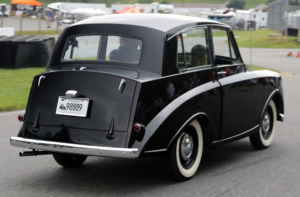
Mayflower – there isn’t a curve in it. Every panel is straight. There’s just tiny little elevation in the panel to keep it straight. Which means if you’re going to put a dolly underneath and hammer on top of it and hit twice, it becomes an oil can. Because it takes the tension off. Did I stuff that door up!
JF: So your total training as a panel beater had come back from this one incident in Germany. You’ve had one month’s apprenticeship in Germany on and off…
MP: Yeah.
JF: And you’ve conned your way into the factory here…
MP: Yeah! So finally I got a job with place called Southern Panel. And I got a car that tried to get between two tanks. By this time I knew how to use a sledgehammer, and I’ve seen how to use a roller and what have you. I was at Southern Panel for about two years. Doing well, it was fine.
JF: Good learning experience?
MP: Yeah, then I open up my own shop in partnership with another guy… and partnerships don’t work, so that’s alright.
Then I opened up a panel beater, subletting one in a Doncaster motor garage. There’s a bloke called Ray Peterson who was running the tow trucks in here, and I hired the back part of his shop and paid him commission off the wrecks that he bring in. That was a good time too because you had to pay cops to ride shotgun on you, because there was a shooting war between tow truck drivers, and sabotages, and oh boy! Was it tough! Except that I had bloody cops running shotgun for me. And I had plenty of work.
My marriage went kaput by this time. My wife and my child left. So I was just standing there and thinking ‘what the bloody hell am I going to do now?’ and I went out freelancing in panel beating. Subcontracting. You go out and say ‘I’ll do that job for you. 20 quid or 50 quid.’
I did that for quite a while – I was doing alright, making money. I didn’t have family to support, didn’t have mortgage, it was alright.
I was working in Burwood when a car came in and while working on it I opened up the boot and thought ‘what the hell’s all this?’ He’s got a 16 mil camera there, and lights… and I thought what’s going on? So I waited till the owner turned up, which was Geoff Bell. Geoff Bell at that time was supplying ‘Nightwatch’ for channel 9. He was running around filming accidents, fires, murders, what have you. And each time he shoots a story it’s seven guineas. And he told me all that. When he came in I said ‘What’s all this?’ and he explained it all. And I thought shit, I can do that! So I went out and bought myself a Bolex.
JF: Your first camera.
MP: My first camera. Bolex.
JF: Tell me about it.
MP: Went up to channel 9 and they said ‘oh no’, and channel 7 didn’t want to know me. By this time I’d already had a little bit to do with ABC radio – because in the meantime I’ve been doing still photography, street photography, and with it I’d got myself on with ABC radio as a stringer providing ‘on the spot’ reports from various places.
JF: But you didn’t really have a journalistic background?
MP: Yeah, wait a minute – journalistic background’s the same thing! You’re a cameraman. You as cameraman go out, shoot and write at the same time. Not like now, where the journalist jumps on the bandwagon.
JF: Oh. And you bought these skills from back home.
MP: Yeah. There was no such thing as a journalist going out with a cameraman. Forget it! Cameraman gets a camera, you go out and do your shooting. Then because your equipment’s so heavy you do your interviews later on. That was it.
*JF: So you supply a roll of film and a dope/dump? sheet?
MP: Yeah. And that’s it. Anyway – I’ve got this link with the ABC radio. The first job I did was a holy statue which had been moved from St Kilda to Donvale…
JF: That’s a film job?
MP: Yeah, that’s a film job.
JF: Just take me back a little bit – you’re doing the panel beating but somehow you’ve got this link with ABC radio because you’re a sort of spotter round the town?
MP: No no, I was spotter round the town while I was doing still photography for weddings – if I run into anything…
JF: So you’ve got a still camera, you’re doing this as well as your panel beating?
MP: Yes, on contract basis. Not full time panel beating. Contract panel beating.
JF: And did you shoot stills for anything else?
MP: Yes, whatever I could. I walked into The Herald. I had an accident. It was quite a good accident! Truck or something like that. I thought I can flog it to the herald. Got to the pictorial editor and said that I used to do a bit of press photography in Europe, which I did, and they said ‘Oh, no, we don’t use substandard.’
*And I said ‘You know, this is Nica?’
And he said ‘Oh, no, we use Graphic…’
And I said ‘Well I’m sorry, I haven’t heard of graphic.’
Graphic was a square black box with a beer bottle in front of it as a lead, and a wooden shutter and a half plate that you push back behind it. You opened up the slide and went ‘Cerlick’ and you shut the *slide and then you got the picture! So as far as they were concerned, Nica was substandard.
So I went to The Sun and said I was looking for a job in photography and what have you.
He said ‘What experience have you had?’
I said ‘A little bit of this and that’ and he said ‘Oh no no no, we don’t do that. That’s substandard for us, you know. We use Graphic.’ I didn’t say a bloody word, you can’t win.
*Anyway, he said “What equipment DID you use?” and I said we used Nica. Sometimes we used two *Nicas, one with a long lens and one with a wide lens. And if we go for anything special we use rolaflex *or rolacorp?
‘Oh no no, we wouldn’t have anything less than half a plate. So you haven’t got the experience, you’re using the wrong equipment. Goodbye.’
So I work in street photography where you stand on the corner and take street pictures, and if people want them they can go and buy one.
JF: You mean you’re taking pictures of pedestrians?
MP: Yes, it was allowed then. It’s not now. There used to be half a dozen guys on the street corners taking pictures. Then you can go to weddings, for each wedding that you take you get about 7 and 6 a roll of film.
JF: I just want to get an idea what these street photographers are doing. Do you show up any time of the day or night?
MP: Maybe in a park or a city thoroughfare and you just stand there.
JF: Just taking photos of anybody?
MP: Yeah.
JF: Who owns the camera?
MP: You own the camera.
JF: Right.
MP: You own the camera and they supplied the film and they supplied the commission.
JF: Who were they? Who was the company?
MP: A place called Progress Films. There were about half a dozen companies in Melbourne that were doing that. Then they stopped it on the street, you had to pay a concession if you wanted to in the park.
And then of course the instant booths came in, and you could make a funny face, and that killed the street photography. But you were still doing weddings.
JF: Right. So to your bow now – you’re doing a little bit of panel beating, photography.
Tell me about that Bolex camera you bought – the first camera. What did you pay for that?
MP: I paid a hundred and fifty pounds.
JF: That’s a lot of money.
MP: Oh yeah, oh crumbs yeah. That sort of equipment was costing money. So not everybody can go and do that…
JF: And this is a clockwork…?
MP: Clockwork, wind up, yeah.
JF: A hundred foot spool?
MP: Yeah. Non reflex. Which means you’ve got to know what you’re doing – your footage, how far from here to there, you’ve got to know your exposure, your parallels, you’ve got to know what you’re bloody well doing! Because every time you press your button, there goes another few feet of film.
JF: If you’re two foot of film down, are you keeping count in your head?
MP: No, there’s a counter
JF: Right. So you’ve set yourself up with a hundred and fifty pound camera. And it takes a fair bit of skill to use that camera.
MP: Of course. But that was second nature to me because I’ve used cameras before. I used 35 mil cameras not for physically making big films but to clean, to oil, to maintain, to set up. I had hands on experience.
JF: So through your links you’ve got a bit of a job at the ABC now.
MP: So I got into ABC doing this first job. ABC employed freelance guys, stringers. Now, a stringer – is an accredited freelance operator, be it journalist, still photographer, cinematographer, radio guy… which means that a company authorises you to be identified that you’re working for them.
But you don’t necessarily have to work exclusively for one company as a stringer. You can be a stringer for 3, 4, 5 different companies. Because each of those companies may have different interest in it. You know, ABC might have one sort of interest and then radio station might have another interest, or newspaper has another interest and so on.
But since, I have sold a lot of 35 mil pictures to The Age and The Sun, because I always had that camera in my pocket.
JF: So in fact The Sun actually started to buy your pictures even though they’d given you the boot?
MP: Yeah!
JF: Your still photos…
MP: It’s not worth it, they pay peanuts for it. Let’s put it this way. Two editions of front page on The Age, on the helicopter crash – in an oil rig. My pictures. I got $100 for it. It’s peanuts. It’s nothing. It’s ridiculous.
JF: But at the same time while you’re doing this little bit of freelance for the local newspapers, you’re getting your news experience aren’t you?
MP: Well, yes you are. You’re just getting wiser, you know. You know how to look for things. Like in the very early stages I had two radios – one that I could tune from one station to another, and the other was tuned right to the very end, which was D24. So you monitor D24 and the cops tell you what they do, you know they talk to each other so you just go and have a look at it.
JF: You’re actually monitoring the cops – in your back bedroom almost?
MP: No, you do it driving in the car, or in the back bedroom or wherever. You just keep listening to it.
JF: So as a stills cameraman and a stringer, it was down to you to listen to the cops and get out there as quick as anybody else, to get the picture.
MP: Right. As a still photographer it wasn’t worth it. There was $20 or something like that for a picture.
JF: Right. So you’re doing that but you’re also a bit of a spy for ABC radio?
MP: Yeah, give the story to ABC radio for which you get 5 and 6. You establish your value and your reliability to the point when you ring, you give the story, and they don’t bother checking because they know it’s right. And it takes quite a while to establish that. The trust.
JF: So your credibility’s growing.
MP: Yes.
JF: So, to find these stories, aside from listening in to the police radio, it’s keeping your eyes open around the town. Is that what it’s all about?
MP: Yeah, it’s just flapping around! Keeping your eyes open – I’ll jump ahead… I can’t remember what *year it was. Some big Fires on a Friday or Saturday. There are a couple of fatalities. Rick Taylor from ABC rang me up and said “Morrie, I’m hiring you for the day. Just drive around and see what you can find.”
JF: Can we come to that a bit further down the track?
MP: Yeah.
JF: So besides the panel beating you’ve got the stills photography, you’ve met Geoff Bell and thought stringer is the life for me…
MP: Well, not full time! I was still doing panel beating and it worked together very well. I only take panel beating jobs if I want to. I’m on the phone if anyone wants to hire me, which means eventually ABC would ring me – as a film cameraman, accredited stringer. I used to average 3-4 stories a week through the ABC.
They would ring me up if they were short of cameramen, if there was something that they wanted their cameraman to get there in a hurry. When eventually I was in the ABC working with the unit, the procedure was:
The cameraman will sit in the cameraman’s room downstairs, and wait for the telephone to ring.
So the telephone rings and the cameramen all dive for it, and whoever gets it first gets the job.
They’ll run upstairs to the newsroom to get the assignment.
The journalist sitting, typing with two fingers will say (speaks in monotone at pace of two fingered typist!) “ T h e r e I s a t r a I n o n f I r e a t B r I g h t o n s t a t I o n. A s s I g n m e n t r e q u I r e d … Fire, people being evacuated, ambulance arriving. What’s the number of the next story? JVC 372. Bert, give it to the cameraman.”
That’s your assignment!
So you get that assignment and you go down to the garage with the assignment, and you get a car. You hop in the car – no petrol – you go to the pump and put some petrol in, then proceed to Brighton to the burning train. Can you imagine that train waiting for you? (Laughs).
JF: Either the train is going to wait and burn for you or…. This doesn’t seem to be a very efficient way of doing things.
MP: That’s the way it was done.
JF: This is how the ABC were treating their staff cameramen at the time?
MP: Yeah. The news.
JF: Right, so the journalists inside were sitting there basically dreaming up what they wanted and almost telling the cameramen to go out and shoot it to their script.
MP: Yeah. To what they imagined.
JF: Right. But this isn’t the life for Morrie Pilens is it?
MP: Well, actually what happened was that Tony Edgleton said to me…
JF: …That name rings a bell
MP: He was press secretary to Bob Menzies. He was the one that was on Holt’s thing. I was very friendly with him, I worked with him at the ABC for along time. He was a very good newsman. He was in charge of organising Liberal Party elections.
Anyway, Tony said ‘Morrie, really you are much more valuable to me on the road. You’re just useless like the rest of us down here. I’ll give you a beat. I’ll give you Geelong exclusively – would you be interested?’
I said ‘Nah.’
JF: Why?
MP: Because I don’t know Geelong! I’ve got to start from scratch.
JF: So you decide to stick as a stringer?
MP: Well at that stage I was supposedly applying for a job with the ABC which takes all sorts of problems by the time you get there – because ABC’s film section was run by ex airforce photographic unit.
JF: The film section?
MP: Yeah. The chief was bloke from ex RAAF. Photographic unit. And the guy who was actually in *charge of hiring and firing was a well known – oops, I’d better not say that – Keith Porteous. Nah, I’m not going to say it!
laughter
JF: Well shall we go on to Morrie at 81 being locked up for defamation…
laugher
JF: I want to get this right. You’ve decided to carry on as a stringer.
MP: Yeah.
JF: And you’re going to get paid if they use it, or how does this work?
MP: No, you get paid to use it. You supply it and if they use it you get paid. If you assigned, and they don’t use it, you still get paid. If you’re not assigned, on spec, they just replace your film.
JF: Are they giving you the stock?
MP: Yep.
JF: Okay. So you are a recognized stringer for the ABC
MP: I’m a recognized stringer for the ABC, yes.
JF: And the deal is ‘here’s some stock Morrie, go shoot whatever you want.’
MP: Yes.
JF: Where’d you get the film processed?
MP: Cinevex (Film Laboratory).
JF: So they didn’t have their own film processing unit?
MP: No, that’s another story. Cinevex started when I started, in a back bathroom by two guys – buggered if I can remember their names – that were doing processing 16 mil black and white film in their bathtub, for the ABC.
JF: Down in Elsternwick?
MP: No, that was later. It was St Kilda first, and then Elsternwick was last I think. CInevex is very big. But why – because the existing film lab would take 2 days to process!
JF: And these guys would do it quick smart?
MP: whistles to indicate very quickly!
Hundred feet of film in the bathtub, no problem. Terrific, you know. And finished up inventing and building their own black and white processing machines.
JF: Were these Aussies?
MP: Yeah. Oh, yeah. Because there are a lot of amateur guys around, you know. Quite a few 16 mil film clubs around. The Rolls Royce of amateur filming was 16mm. Because 8mm was just, forget it. Cinevex started in a bathtub!
JF: Two men, in a bathtub…
MP:…. Supplying ABC film instantly! On everything, 2 hours.
JF: Which in those days was pretty quick.
MP: Oh, come on! That was absolutely… Even newspapers couldn’t compete with it.
JF: Is that right?
MP: Yeah, of course not. They had to make bloody run – reset the whole thing, you know. It just didn’t work.
JF: Were there many stringers running around town?
MP: Well, at that stage Lloyd Rankin was main stringer (he was ex army signal corps I think)
JF: He ended up working for channel 0?
MP: No no no, Lloyd Rankin’s never worked for anyone else but ABC as a stringer. Then we had *Lockhov Lord? I can’t think of his other name. He was president of the 16 mm society, he lived in the hills somewhere. I would say there were about half a dozen perhaps.
JF: What year are we talking?
MP: Oh, this is the early 70s.
JF: So 9 and 7 are on air by then.
MP: Oh yeah, they on air.
JF: Have they got stringers working for them as well?
MP: (Laughs) Anything shot by ABC outside the metropolitan area – imagine the metropolitan area, Bulla at one end and stopped at other somewhere…. Shot by the ABC, had to be supplied to channel 9 as well. So I shot film for ABC and got it on ABC and channel 9.
JF: Were you getting paid twice?
MP: No.
JF: So what, if you shot something for the ABC outside the metropolitan area…
MP: … Oh yeah, channel 9 automatically said ‘We want that!’
JF: What, were they given a print?
MP: Yeah.
JF: It would be a bit of a slow down wouldn’t it, did the ABC sort of slow it down before they gave it?
MP: No. No. That was just in the Cinevex they just run the print automatically because that was the deal somehow between ABC and 9. To help. They pooled up and coming technology.
JF: And the poor Packer family!
MP: Yeah.
JF: So let me get this right. ABC would tell channel 9 the story had been shot, and 9 would say ‘Give us a print?’
MP: No, channel 9 would ring ABC and say ‘What are you shooting outside metropolitan area?… We want that, we want that… thankyou.’
JF: So when your film was taken to Cinevex…
MP: That’s it
JF: You hand it over, but a print is made for channel 9’s news.
MP: Yes. That’s alright isn’t it. Because you help an up and coming technicality.
JF: Was 7 in on the same deal?
MP: No. They weren’t quick enough to jump on the bandwagon. 7 had their own problems, they had a news editor who was an ex cadet shooting officer, and he didn’t really have a clue what he was doing. *Stuart Lake (?). Oh GOD! (laughter). Boy oh boy.
He’s running channel 7’s operation in Melbourne
JF: We’ve got a little ahead of ourselves haven’t we.
MP: Yes, miles ahead.
JF: Because in fact, while you’re stringing for the ABC, where’s the link for you with eventually doing stuff for channel 7?
MP: That comes after I leave ABC. I say ‘Now I’m going to go stringing, freelancing.’
JF: But you’re not on the ABC’s payroll full time at any stage, are you?
MP: No, well, full time temporarily. Because I had an application in ABC for a job. To apply for a job with ABC you apply for an existing job that has to… you’ve got to go through about 3 little loops before you’re even considered for it. I don’t know how it works, but it was a temporary position, that you may or may not get to go to the permanent position. Which is just (blows raspberry) – the whole thing.
*I did have an interview with Keith Porteous?, the chief camera, news department film section, and being an ex Royal Air Rorce Officer, I don’t think he was very impressed with me basically. And secondly, you couldn’t get a job with ABC unless you were a Pom.
JF: Yeah?
MP: You couldn’t have a bloody wog going down there and working for ABC. Goodness me, oh, not on! It changed, but it took a while.
JF: So it was a bit of an old boys school?
MP: Oh yeah. Definitely old boys school from the beginning. You had to know somebody who knew somebody who knew somebody, and then you had to have your background checked out so that you’re the right kind of person.
JF: So it was a bit beaurocratic?
MP: Oh yeah, very beaurocratic. So I went back around, then by this time there was a bloke called John *Carnomower? who was TCN 9’s representative in Melbourne. They hired him and paid him full wages to work in Melbourne. And he was going back to Sydney because his father was running some sort of fishing business and what have you, and he wanted to get out of it anyway. So he recommended me to TCN 9 as a Melbourne representative. So I got the job. I got an office in channel 9. A little broom cupboard or what have you.
JF: And this is going to be full time?
MP: This is full time. But it was a funny full time because they said ‘Look, we’ll only select what we want, but you try and be nice to other people so that you are in circulation so that you can meet people, and if you have to shoot something for somebody else you shoot it, you know. We keep a close eye on it.’ It was alright.
JF: This is nothing to do with channel 7, this is channel 9?
(Note, verbal reference to TCN9 should be ATN7)
MP: This is channel 9 in Sydney. So I work for TCN out of channel 9’s newsroom. News editor was Peter *Moghan. His offsider was Graham Freudenberg. ! I got on with Fraudy very well. We had great discussions of propaganda and Goebbels and Germany and what have you. I’m jumping ahead now.
And Freudenberg used his skills that he learned from all this, from Dr Goebbels and what have you, to prepare Mr Whitlam for his ‘It’s Time’ election campaign.
JF: Did he?
MP: And proof of the pudding is, when I was filming ‘It’s time’ at Springvale Town Hall, and Whitlam was doing his speech, and I just went out to the foyer to go on the balcony and get a home shot, there’s Graham Freudenberg in the foyer, walking up and down that foyer, and conducting Whitlam on the stage.
Including poses, including movements in his hands, he was walking up and down and saying blah blah blah blah, one, two, blah blah blah. And was physically conducting him from the foyer. Of course, Whitlam couldn’t see him, there was nobody there. But you could tell that whatever Whitlam’s doing, whatever Whitlam’s saying, it’s been drilled into him.
JF: Right.
MP: Up to the point where there’s complete repetition. And then I looked at it and went up – I didn’t film him, unfortunately! – anyway, went out from the top and I’m watching Gough – and if that isn’t Dr Goebbels with his bloody hands, talking with his hands, I’ll eat my hat!
Laughter
JF: So Fredenberg had been over with Goebbels?
MP: No no no. Freudy was very left wing. He’s a good journalist. He just liked to use his skills to get things done the way he wants them. We talked about how Goebbels could sway the masses. Hitler could persuade masses and we could dissect it. I had some books and gave them to him to read, and he had some books. I got on very well with him. He was just an interested person. He was a film director.
JF: And he was running the channel 9 effort?
MP: No, he was second in command at channel 9. And then he left that job and went to somebody’s secretary, and somebody’s secretary. Anyway. Lost touch with him but… in the very early piece it was quite interesting, you know. Sorry for jumping around.
JF: That’s okay. We’re back in the channel 9 newsroom. You’re actually shooting for TCN 9?
(Verbal reference to TCN9 should be ANT7)
MP: I’m shooting for TCN 9. TCN 9 sent me a big bloody sound camera as well. Pro 600. So what I do is go out, shoot, if there is an interview I con bloke whoever’s going to interview – so with the Pro 600 with optical sound, there are certain procedures.
*Say for instance, a typical thing was a bloke called Gunn, who was in charge of Australian Wool Board… There was some sort of problem with the Wool Board and what have you, big story. So I arrive at press conference, bloody Pro 600, and Bell and Howell. So I just shoot couple of shots with Bell and Howell, then everybody goes through press conference. When we finish press conference I walk up to him and said ‘Look, I’m by myself, I’m with TCN, I’ve got to do an interview, could we do it this way?’
So he’s just sitting there, put your camera down and say ‘Look, it’s no good talking for half an hour. Just the crux of the matter. If you could talk to me for 30 seconds, whatever you want to say. And to start it all I’m going to ask you a question, and you’ll have to wait about 3 seconds before you start talking to me, to the camera, for cutting purposes.’
So rolling camera, say ‘camera rolling’, then ask him the question, stop. He comes to the answer, he gives you blah blah blah. He says ‘That what you want?’ I say ‘Yes, thankyou very much. Goodbye.’
JF: So you’ve shot this, you’ve got no journo with you…
MP: No.
JF: And in fact channel 9 in Melbourne have probably just got the same shot themselves, but you’ve got to just shoot an exclusive bit for Sydney, so that’s gonna work.
MP: Yeah.
JF: Then what happens?
MP: I just pack it up and send it off to Sydney.
JF: Do you take it out to the airport?
MP: Yes.
JF: So do you have a cut off time during the day, or if it doesn’t make tonight’s news it just gets on tomorrow night’s news?
MP: Yeah. But eventually what I organised was – laughs. I’ve got to get to this one, because this will illustrate what’s happened…
TCN would say they want golf coverage. They want hundred feet for TCN, hundred feet for Adelaide and hundred feet for Tasmania. So I go out there and I’ve got to pick out who I’m going to shoot. And I roll off hundred feet of one guy, and roll off hundred feet of another guy, and roll off hundred feet of last guy, and last guy happened to be Norman from Nide. And he gets his ball in the rough, which is across the bloody fairway. So I set my camera up, at this stage I had a Pathe which is a reflex camera, and I set it up and I’m just lining it out there and few frames he’s going to get himself out of there. He comes up to me and says ‘You get away from here… get your camera out.’
And I said ‘Okay, I’ll get somebody more important!’
I just lining the camera down there, standing there. It was a silent camera. And off he goes, as soon as he starts I just pressed the trigger, and I let it roll. And I’m looking all over the place. And he had three goes, finally got out. So, okay, bye. Lovely.
Unfortunately I sent that to Tasmania instead of Sydney! And Sydney got newspaper pictures of me being threatened with a golf club. He say ‘where’s that bloody fellow’. I sent it to Tassie!
JF: So you’re shooting one event for Adelaide – you’re sending the tape to Adelaide, as a film. You’re sending the film to Tassie, and you’re also sending it up to Sydney as well.
MP: Yeah.
JF: Wow.
MP: That’s silent footage. You know, that’s nothing.
JF: But you’ve got to do one story for three markets.
MP: Yeah. That’s alright. You can do that.
JF: But what happened if you had to do an interview for each of those markets. Did you get the talent to do the same interview…
MP: … three times!
JF: Are you serious?
MP: Yeah. No problem. Because all depends how you approach people. My best friend was the chairman of Melb Metro Board of Works. Now what was his name. He lived in Warrandyte. His name will come to me…
Anyway, there was some problem with cracking pipes and what have you, everyone *doing hot interviews and what have you so all finished. Coxy! Alan Croxford. So I got to him after the press conference. I said ‘Look, I’m working for TCN Sydney, and I’m covering Tasmania and Adelaide. I would like to have an interview with you, but I have to do it three times.’ I explained that ‘what I’d like you to do, instead of all this bullshit that’s been going on, I’d just like you to answer one question in about 30 or 40 seconds.’
And he said ‘Yeah, that’s alright, that’s okay.’
So we do one, do two, do three. That’s alright. And he said ‘Gee Morrie, I learned something from you.’
And I said ‘Well, that’s the way it is.’
So he called me months later, and there were three other executives there, and I had to explain to the executives how I did the interview, instead of stupid bloody questions and talking for an hour. You just say something and you stop. Because that’s where you want to cut. And then you say something, and stop. Answer a question and then you’re going to stop.
JF: So you’re teaching them the sound bite.
*MP: Yeah, exactly. And I got a bottle of bloody scotch out of him! Did the same thing with Reiler? Reiler asked me, after I did one of those band things.
JF: These days of course they let people ramble on.
MP: You got so much bloody tape here!
JF: Film?
MP: Film you couldn’t do that. Oh well, they still did. Because once the journalists came in, that was the end of it. Because they just keep talking. They think you never gonna catch anybody out in 400 feet *of film. Like the first job Sam Liebske? did with me. I was still with ATN 7 working out of Channel 9’s office, and Peter Moughan said ‘Look’
I said ‘I’m going off to Maffra.’
Peter Moughan says ‘No, we’ll give you all the film from Maffra, if you do some jobs in town.’ I said okay, no problem.
*So I got Sam Liebske on his very first day out. We shot 400 feet of the ‘Santamaria,’ we interviewed 4 people and each one was 400 feet of film. I kept telling Sam ‘You can’t use all that, you know.’ And he wasn’t taking notice because, you know, they just want to talk themselves. And what happened was when the film came in from Maffra, Peter Moughan did not give me that film ‘til 12 oclock at night. Bastard!
JF: Why?
MP: He just wanted to delay. When he came back about 3 o’clock I could have had it and could have had it airing – so you learn that you don’t trust people.
JF: Just going back to this idea of being a film cameraman then, you’re very aware of timing, and you’ve got to get what you want very quickly in an interview?
MP: Yeah, basically, finished cost on air is a dollar a foot. So if you shoot a hundred feet of film and you’re going to have fifty feet going on air, that’s 50 dollars. That’s a lot of money
JF: I’ve just got to turn the clock back now. I’m thinking 12 feet of film ran 20 seconds, something like that.
MP: Yes.
JF: So you would try and get your soundbite with, say, the head of the board of works, pretty quickly?
MP: Yeah.
JF: Don’t waste my film.
MP: And you tell him that, you know. ‘Say it quickly and say it precisely, and once you’ve said that, stop! Because we have to cut there. And then I’ll ask you another question, and we wait for three seconds, give me another answer, and stop.’ And it works beautifully.
JF: I want to clarify for the purpose of the tape, because we have been talking about working for channel 9 in Sydney, but in fact you were working for channel 7 weren’t you.
MP: I’m sorry. ATN 7 in Sydney I was working for, not channel 9.
JF: Right, okay. So we’ve just got to wind all the way back in our minds that ATN 7 you were working for, not TCN 9.
MP: So at that stage, 7 in Sydney and 9 in Melbourne were supposed to be sister stations. There was no network numbers established. That’s why I’m working with Melbourne channel 9, and ATN7, Sydney.
JF: Why didn’t channel 9 in Melbourne just shoot something and give it to ATN 7 in Sydney?
MP: It’s too complicated somehow, I don’t know why.
JF: Well it would have put you out of a job for a start
MP: Yeah. So 7 Sydney decided to amalgamate with 7 in Melbourne. So I get instructions from 7, we going to break with 9, working with 7. Your office is going from channel 9 into our transit in High st, Kew. Your job is to soften up 7 so we can communicate.
So I stupidly turn up at 7, try saying hello. I go out and shoot some film and offer it to them. One of the jobs I shot for them was Ryan (Ronald) and Walker thing. Just after they escape. And I had the Pro 600 *which I put on the tram line, and I grabbed an Age reporter, Jake Darmetty? He was a bit of a character. Told him what to say, to do, to bloody stand up for me. With Pentridge in the background. So we did twice – one for ATN and one for 7. So I gave it to 7.
JF: Are you telling me you just rocked up to a newspaper journalist and said ‘do this for a tv channel…’
MP: Yeah, and here’s 5 bucks.
JF: What?
MP: Yeah eh.
Laughter
MP: No problem. I just tell him what to do and how to do it, and there’s no problem.
JF: You’ve just walked up to a newspaper journo…
MP: I knew him well…
JF: but he would do that, with…
MP: No problems!
JF: There’s really no conflict of interest with his newspaper anyway
MP: None whatsoever. It actually enhances if his head’s appearing on the bloody television.
JF: But he would just do a stand up, as a report, so there’d be no need to do a voice over or anything like that.
MP: No voiceover, it’s silent footage. And then he cuts in as a stand up, about 30 seconds you know.
JF: So who would actually speak the voice over? Would that be from the studio floor?
MP: I do the film, I don’t know, it’s out of my hands.
JF: Alright, but in fact, if we were to be looking at that story today – we whiz back 30 odd years and look in the archive – the voice over is done by someone else. And then up pops this newspaper journo from Melbourne, who you’ve flicked 5 bucks to, to do HIS report about what’s happening on the spot.
MP: Yeah. That’s how it works John! I couldn’t jump in front of it because of my accent otherwise I would have done it myself!
Laughter.
JF: They were different days weren’t they?
MP: Oh crumbs, they were bloody good days, yeah.
JF: Who were some other characters who were on the road in those days?
MP: Oh, Diamond Jim, Mel… some political journalists, Mailing and
JF: But the cameramen, where did they all come from? That were running around the town?
MP: Well, it’s very interesting because the cameramen that worked for the television stations all had some different backgrounds. Like, Lloyd Coulson was an ambulance driver.
JF: That’s the man who ended up with channel 10.
MP: No.
JF: Okay. Didn’t he end up in the processing department?
MP: No, Lloyd Coulson was at 9, he got the sack and he died.
JF: So. Lloyd Coulson, ambulance driver, becomes cameraman. Morrie Pilens, panel beater becomes cameraman.
MP: Oh yeah, wait a minute.
JF: Who else is there?
MP: There’s another background in there. Ray Rowe. Got into job because he and his father were sitting all night listening to police radio and ringing up channel 9 and giving tips where to go to. So eventually he got himself a job as a cameraman.
JF: And I think we should add for the record, Ray Rowe ended up at channel 9 for many years, and now works for the ambulance department again!
MP: Yes, because he got the sack from 9, like everybody got the sack from 9. Ray Rowe started out as an ambulance chaser and he was desperate to get a job.
JF: And he ends up as a cameraman. So you’ve got Ray, Lloyd, yourself… What about Geoff Bell? He’s still driving around as a stringer.
MP: Oh yes yes. But he wasn’t interested in working for anybody, because he had a bit of a private income from his father’s factory. And he was just chasing accidents and doing well.
JF: Doing well. Right. As a stringer cameraman in those days could you make a living at it or did you have to be doing something else?
MP: Oh, no you couldn’t… well, for instance, Geoff Bell was making a very good living because he had this ‘Nightlife’, you know. And then channel 9 decided that they were paying him too much money for it.
JF: So ‘Nightlife’ was in fact just chasing ambulances. Did they just do that one night a week?
MP: Just on the weekends. That was one night a week but Geoff was chasing other stuff during the week as well.
JF: Right. But you’re now working for channel 7 Sydney. What would you have been paid then?
MP: I can’t really remember. It would have been basic, with a little bit of mileage.
JF: Had they given you a car?
MP: No. Just camera. Some camera, I used silent camera of my own.
JF: So you’re driving your own car to all these…
MP: Yes. Or you can charge….?
JF: So you’ve got a black and white, sound optical…
We’ll talk about the equipment a bit later because I think that would have made a big change to things
MP: Oh crumbs yes.
JF: That’s something to talk about another day.
So you’ve lopped up now to channel 7, you’re shifting camp.
MP: Yeah, well, I’m crawling to them! I’m really sucking up to them, left right and middle.
JF: Because you’ve worked alongside of them in a way, and you’re a competitor in a way…
MP: Yeah, and things are doing well, and we’ve established contact, and channel 7 got happy with ATN 7 Sydney…
Before we finish this I must tell you one story seeing it’s Caulfield Cup day. Do you know how we covered the Caulfield Cup? On the top of the roof – this is for channel 7 Sydney. On top of the grandstand, I’ve got camera on tripod, a hundred feet of film, all loaded. Because we used to wind our own film. Four races, you needed that little bit extra.
With three lenses I’m filming the race. Started the race, going around the corner, switching lenses, going around the corner, switching lenses, coming down towards the finish, finish, just run off a little bit, wait, just wait til it comes back into the enclosure. You get him coming in through the gates down there, take your film out of there, put it in the can, wrap it around with sticky tape and go to the edge of the roof, and say ‘HEY!’ (Whistles). And throw it down!
JF: Yeah?
MP: Yeah. And there’s a taxi guy waiting for me, to take it to the bloody airport.
Laughter
MP: Besides that, at the airport I’ve got a guy who’s taking the film and giving it to the pilot.
JF: Right.
MP: And an hour later, two hours later, it arrives in Sydney.
JF: And this isn’t just about being a cameraman is it. This is about being a man who’s going to fix the problem, and sort out the taxi…
MP: No, this is a news film cameraman. Because the best bloody story in the world’s no good in your camera. Really. You have it, get rid of it! And how you get rid of it’s up to you. I’ll tell you the story about the helicopter crash, how I got that film.
JF: I’m familiar with that story, again it’s one that we’ll come to.